

DEAFMIRROR 2.0
One tool, two hard-of-hearing users, two audiograms. A conversation about what it means to hear someone else’s hearing.
DEAFMIRROR started as a personal question:
what does my hearing actually sound like to someone else?
The first version answered that for one person, with one audiogram, from one specific date. Version 2.0 asks a different question:
what if anyone could do this?
This post is written together with Zeinab from Beyond Deaf-inition. We are both hard of hearing. We both live with audiograms, hearing aids, and the daily work of filling in what isn’t there. We speak about what the tool does, where it falls short, and what it’s like to hear your own hearing loss reflected back at you from the outside.
Who we are
Gaetano is a sound artist based in Hamburg. Anthropologist by training. His work moves under the Deaf- prefix: Deafnotes, Deafdrones, and now DEAFMIRROR. The prefix is intentional and political, not a euphemism. He has sensorineural hearing loss, bilateral, progressive, asymmetric. His right ear sits at a clinical threshold that medicine calls severe, bordering on deaf.
Zeinab is a hard-of-hearing person, but hearing loss doesn’t define her. She wears many hats as well as a pair of hearing aids. Her work varied between translation, writing, QA, housekeeping, and pet-sitting. She writes to heal and to raise awareness. She’s been on a journey of self-discovery since the end of 2023. She’s learning how to navigate the worlds of hearing loss and depression on her own and to speak up about them. This collaboration is one step ahead on the right path to learn more about the world of hearing loss and to gain confidence explaining it to others.
What changed in 2.0
The first version of DEAFMIRROR was locked to my own audiogram. You could hear my hearing loss, but not yours. That was a main limitation, and also a kind of honesty. It was a portrait, not a platform. But the question kept coming up: could someone else do this with their own data?
2.0 introduces what I ended up calling a two-door system. When you open the tool, you choose your path.
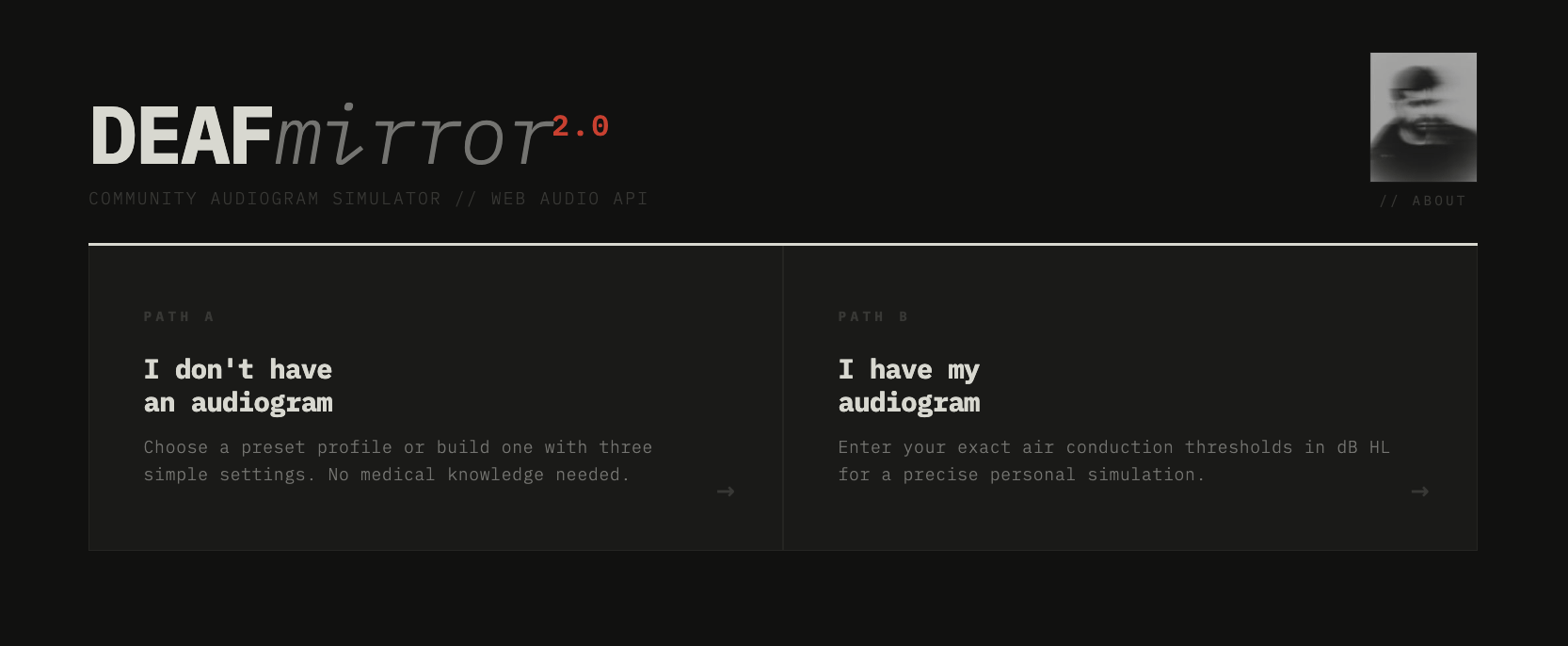
Path A is for people who don’t have an audiogram, or don’t want to enter one. You choose from a set of preset profiles: mild flat loss, moderate high-frequency loss, severe bilateral, asymmetric, and so on. These are generalized shapes, not individual measurements. They give you a rough sense of what different kinds of hearing loss sound like without requiring any personal data.
Path B is for people who do have an audiogram. A four-step wizard walks you through reading it: what the grid means, how to identify the symbols for left and right ear, how to enter your values, how to apply them. There’s an annotated example using my own audiogram in step three, so you’re not reading abstract instructions in a vacuum. You’re reading them next to something real.


Once you’ve entered your data, the simulation works the same way as 1.0: Original, Without Aid, With Aid. Three modes, your frequencies, your ears.
The tool is still a single HTML file. No server. No data collection. Your audiogram stays on your machine.
Two audiograms
Gaetano: My audiogram is sensorineural, bilateral, progressive, and asymmetric. Worse on the right, worse in the high frequencies, significantly so above 1,5kHz. The right ear sits at a pure-tone average of 72 dB HL. The left is measurably better, but not by much.
What that means in practice: I hear speech, but not clearly. I follow conversations, but with effort. Music reaches me differently than it reaches most people, which is part of why I work with sound the way I do. The high-frequency detail that carries consonants, presence, air, most of that is gone or heavily attenuated. What remains is a lower, flatter, more effortful version of the acoustic world.
And it’s getting worse. Sensorineural hearing loss (SNHL) caused by cochlear damage doesn’t stabilize on its own. The audiogram from January 2025 is a snapshot, not a fixed state. The curve trends in one direction, and I have no reason to expect that to change. What DEAFMIRROR simulates is where I am now. Not where I was, and not where I’ll be.
That trajectory is part of why projects like this matter to me as much as they do. If my hearing is going to keep changing, then documenting what it sounds like now, at this specific point in time, feels important in a way that’s hard to fully articulate. It’s a kind of artistic record-keeping. A footprint. Not a lament, just a mark.
Zeinab: Contrary to Gaetano, my left ear is the worst. It has a profound mixed hearing loss which is a mix of conductive and sensorial hearing loss. It means my left ear hears only extremely loud sounds and no speech at all.
My right ear, which I heavily rely on, has a moderately severe sloping SNHL. Sensorineural hearing loss (SNHL) is the most common type of hearing loss. It results from damage in the inner ear nerves and hair cells. What’s the reason behind this damage in my case? I don’t know, and I’ll probably never know since this should have been inquired when I was young. My hearing aid helps me a lot on the right side.
Although hearing in the right ear is much better than in the left, I still struggle to hear and understand speech at a normal level. My hearing in this ear sharply slopes from 20 decibels at 250 hertz down to 75 decibels at 4000 hertz. Accordingly, I miss a lot of the high-frequency sounds. A watch ticking, a tap dripping, a bird singing, distinguishing between the S and the Th, etc
How do I survive? I extensively and unconsciously lipread, read facial clues, and I guess a lot. This means that my brain is working extra shifts all the time which leads to exhaustion and fatigue by the middle of the day.
Testing the tool
Gaetano: What I wanted to know when I asked Zeinab to test it was not whether the simulation was accurate. We both know it’s an approximation. What I wanted to know was whether it felt meaningful. Whether entering your own numbers and hearing the result told you something, even if that something was “this isn’t quite right.”
There’s a particular strangeness to hearing your own hearing loss from the outside. I felt it building the first version. You know exactly how you hear, you’ve lived in it for years, and then you listen to a simulation of it and it’s both recognizable and slightly off. Like a photograph of your own face taken from an angle you don’t usually see. You know it’s you. But it’s also not quite the version you carry around.
The WITH AID mode produced a different kind of strangeness. Zeinab and I both noticed it: hearing what your aided hearing could sound like, according to a formula, is an unsettling experience. Not because it’s wrong, but because it confronts you with a version of your own hearing that is hypothetical. It’s not how you hear with your aids in. It’s how the prescription says you might hear, under ideal conditions, if everything were working exactly as intended. For both of us, it felt odd. A possible self, acoustically rendered, that doesn’t quite match the actual one.
Zeinab: When I read Gaetano’s post about DEAFMIRROR, I was curious to try it. I did and shared my experience in a comment with Gaetano. I remember I told him that I heard nothing when I picked “without aid” option. He asked me whether I’d be interested in having the option to adapt the tool according to my hearing, a generous offer that I unhesitantly welcomed.
After I received the new version of DEAFMIRROR from Gaetano, I added my data, uploaded a song and tested it. Here is my feedback on the trial.
For the left ear, the options of “with aid” and “without aid” sounded the same; I heard nothing! I know my hearing loss is profound in the left ear (a hopeless case as my audiologist told me once), but I thought I would hear “some noise” at least.
For the right ear, the sound coming through the options of “original” and “with aids” sounded the same, fair and clear enough. As for the without aid option, the sound was vague as if it was coming from a far planet. When I chose the two ears at the same time, “with aids” option sounded much worse than how the original did. In some parts of the song (for instance, when there was slow, quiet music), I heard almost nothing. Needless to say that I also heard only silence, when I listened to the sound “without aids in both ears” option.
Where the simulation falls short
Gaetano: The WITH AID mode is still a sketch. The NAL-NL2 formula gives an estimate of hearing aid gain based on the audiogram, but it doesn’t know what your actual devices do, how they’re calibrated, or how your brain has adapted to them over years of use. I calibrated mine subjectively. I listened and adjusted until it sounded roughly right. That is not the same as a measurement.
More broadly: the simulation models the signal. It doesn’t model the effort. It doesn’t model what it costs to listen in a loud room, or the way you unconsciously lip-read at the same time, or the cognitive work of filling in from context what you can’t actually hear. It doesn’t model the fatigue that builds up over a day of effortful listening, or the particular exhaustion of a room where everyone is talking at once. The audiogram is a threshold test. It is not a portrait of a listening life.
Zeinab: I was shocked to “hear” how bad the sound was with the option of “two ears with aids”. If that was how I hear in my day-to-day life despite wearing my hearing aids, how am I coping with all the listening and missing simultaneously?
It has only one answer. I make extra efforts all the time. My brain works 24/7. As Gaetano mentioned above the stimulation doesn’t reflect how much effort we make and all the consequences of making this effort throughout the day. That has had a toll on my energy, mental health and even personality.
On comparing hearing losses
Gaetano: One thing that became clear in building 2.0 is that hearing loss is not a single thing. The preset profiles try to name some of the common shapes: flat, sloping, severe, profound. But even within the same audiometric category, two people’s experience can be completely different. Age of onset matters. Whether you grew up hearing or not matters. What you’ve adapted to, what you’ve learned to fill in, what sounds you miss and which ones you’ve stopped noticing you miss: none of that appears on the audiogram.
Talking to Zeinab about her hearing is not like looking in a mirror. It’s more like comparing maps of different territories that happen to share some geographic features. The category is the same. The experience is not. That gap between the clinical label and the lived reality is exactly what DEAFMIRROR is trying to make audible, and it’s also exactly what no simulation can fully close.
Zeinab: One of the things I wished I could have was an option to let my friends hear the same way I hear. I think DEAFMIRROR might be the seed to grow such an idea, thanks to Gaetano.
The software still needs some work. Also, it doesn’t reflect how much my hearing aids help me hear or even in which areas it doesn’t / can’t help at all.
Gaetano and I are hearing impaired, but we experience hearing loss differently. Also, living in totally different countries affects how we experience our hearing loss. In Egypt, where I am, many services for hearing loss are poor or not provided at all. For instance, my left ear qualifies for a cochlear implant, but this surgery isn’t covered in public health insurance for adults. In addition, Real-Ear Measurement which evaluates how good or/and bad hearing is with the help of aids isn’t available where I live.
A long way I navigated on my own while learning about my hearing loss. Still, I have to continue walking this way, and with the generous assistance of people like Gaetano, I’m learning a great deal.
Try it
→ Open DEAFMIRROR 2.0 in your browser
(Works on desktop in Chrome or Firefox. Choose Path A for preset profiles, or Path B to enter your own audiogram data. Load any audio file: speech, music, ambient sound.)
The tool runs entirely in your browser. No data is collected or uploaded. Your audiogram stays on your machine.
I’d like to take this opportunity to once again sincerely thank Zeinab for our conversation and collaboration. I hope this will help us reach others as well.
Be sure to check out Zeinab’s Substack—it’s well worth a read: